
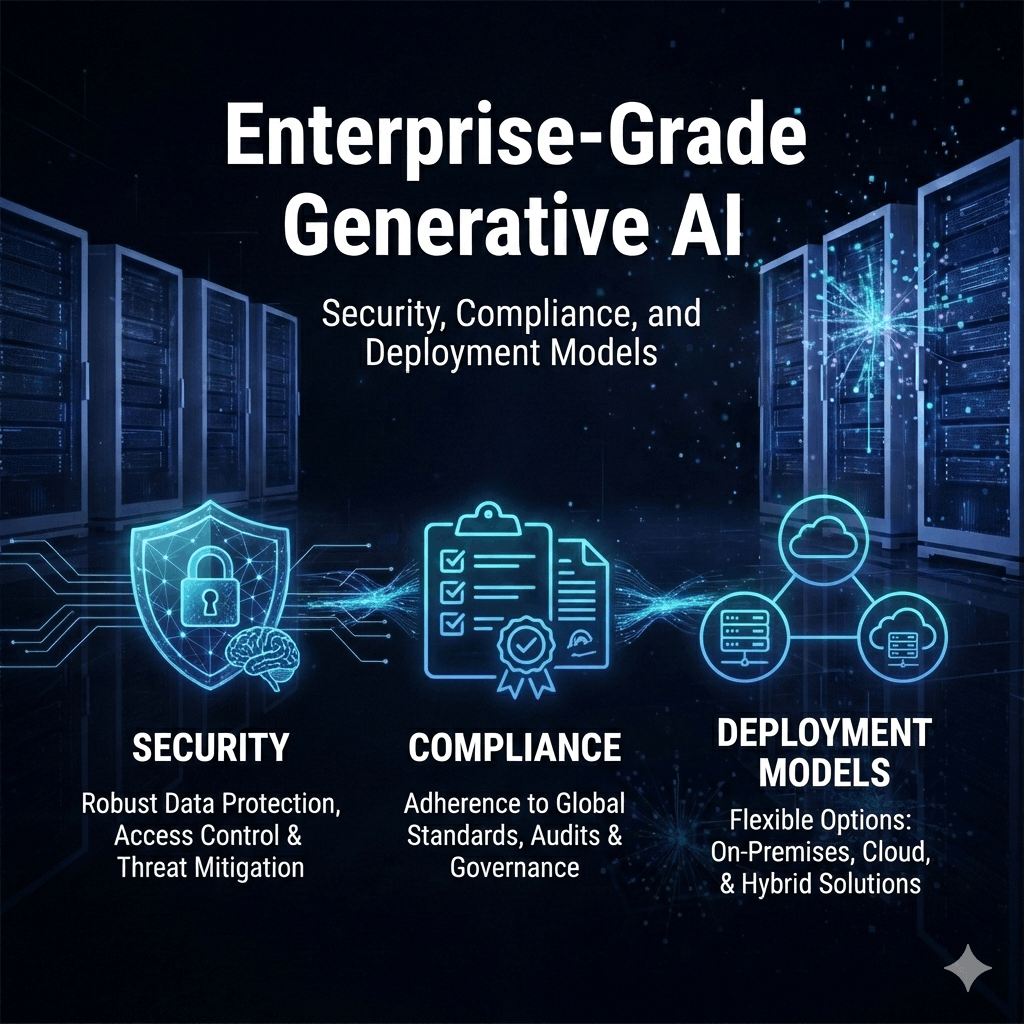
Enterprise-Grade Generative AI: Security, Compliance, and Deployment Models
Generative AI looks deceptively simple from the outside. You connect an API, send a prompt, and get an answer. For consumer tools, that’s often enough.
Enterprises operate under very different rules.
When generative AI enters an enterprise environment, it immediately collides with security controls, compliance requirements, audit trails, and long-lived systems. The question is no longer can we use AI? but how do we deploy it without creating new risk?
This article breaks down what “enterprise-grade” really means for Generative AI and LLM systems, focusing on security, compliance, and deployment models that hold up in production.
What Makes Generative AI “Enterprise Grade”?
In an enterprise context, Gen AI is expected to do more than produce useful output. It must:
- Protect sensitive data by default
- Comply with industry and regional regulations
- Integrate with existing identity and access controls
- Produce outputs that can be audited and explained
- Operate reliably at scale
If any one of these fails, adoption stalls often quietly.
Security: Where Most Enterprise Gen AI Projects Break
Data exposure is the first concern
Enterprises worry less about model quality and more about where data goes.
Key security questions include:
- Is prompt data stored or reused?
- Who can access generated outputs?
- Can sensitive information leak across users or teams?
Enterprise deployments typically address this through:
- Private networking or VPC isolation
- Encryption at rest and in transit
- Strict data retention policies
Public Gen AI tools rarely meet these standards without additional controls.
Identity, access, and least privilege
In enterprise systems, AI should not have broader access than the user invoking it.
Mature implementations:
- Tie LLM access to enterprise IAM systems
- Enforce role-based output restrictions
- Log every request and response
This ensures AI systems behave like any other internal service, not a special exception.
Compliance: AI Is Now in Scope
Generative AI systems increasingly fall under existing regulatory frameworks.
Depending on the industry, this may include:
- Data protection laws
- Financial regulations
- Healthcare compliance standards
- Internal governance policies
Enterprises handle this by ensuring:
- Training data sources are documented
- Outputs can be traced back to inputs
- Models can be updated or restricted quickly
The key shift is treating AI as regulated software, not experimental tooling.
Deployment Models That Enterprises Actually Use
1. API-based Gen AI (with heavy guardrails)
This is the fastest entry point:
- External LLM APIs
- Strict prompt filtering
- Output validation layers
It works well for low-risk use cases like summarization or internal knowledge search, but requires careful monitoring.
2. Private or hosted LLM deployments
Larger organizations often choose:
- Cloud-hosted private models
- Dedicated inference infrastructure
- Full control over data flow
This approach trades flexibility for control and predictability, often the right choice in regulated environments.
3. Hybrid Gen AI architectures
Many enterprises land here:
- Sensitive workflows stay private
- Lower-risk tasks use external models
- Retrieval layers control what data the AI can see
Hybrid deployment balances cost, performance, and compliance better than any single approach.
Why Governance Must Be Built In, Not Added Later
In enterprise environments, governance cannot be a policy document alone.
Effective Gen AI systems include:
- Versioned prompts and models
- Audit logs for AI decisions
- Clear escalation paths for failures
Teams that treat governance as code not process move faster over time because trust is already established.
Some organizations, often with input from implementation-focused partners like Colan Infotech, have learned that early governance design reduces friction far more than late-stage reviews ever could.
Common Enterprise Use Cases (And Why They Succeed)
Enterprise Gen AI works best when:
- The problem is well-scoped
- The data source is controlled
- The output is assistive, not authoritative
Successful examples include:
- Internal knowledge assistants
- Compliance document analysis
- Customer support augmentation
- Developer productivity tools
These use cases scale because failure modes are understood and contained.
What Enterprise Teams Learn After Deployment
A few patterns show up repeatedly:
- Smaller, well-governed systems outperform large, loosely controlled ones
- Evaluation and monitoring matter more than prompt creativity
- Trust grows when humans can override AI easily
These lessons shape second-generation deployments far more than vendor promises.
Final Perspective
Enterprise-grade Generative AI is not about using the latest LLM. It’s about building systems that respect security boundaries, satisfy compliance requirements, and fit into long-term operating models.
The organizations that succeed don’t rush to deploy AI everywhere. They deploy it deliberately, in places where the value is clear and the risk is understood.







0 Comments